Mesh Refinement
Sometimes the meshes generated will be too large (not enough spatial resolution) leading to low quality solutions. To solve this: fish2eod provides domain level mesh refinement highlighted here.
"""Example of a mesh refinement procedure."""
import matplotlib.pyplot as plt

from fish2eod import Circle, QESModel, Rectangle


class SimpleModel(QESModel):
    """Define a simple model with a circular background and a few geometric objects."""

    def create_geometry(self):
        bg = Circle((0, 0), 10)
        r1 = Rectangle.from_center((3, 0), 3)
        r2 = Rectangle.from_center((3, 0), 1)
        c = Circle((-3, 3), 2)

        self.model_geometry.add_domain("bg", bg, sigma=1)
        self.model_geometry.add_domain("fg", r1, sigma=1)
        self.model_geometry.add_domain("fg2", r2, sigma=1)
        self.model_geometry.add_domain("fg3", c, sigma=1)


"""
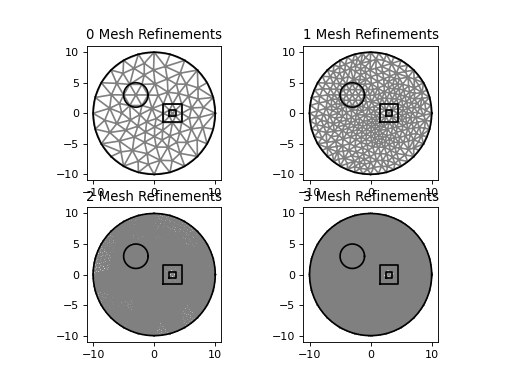
Highlight how mesh refinement works by remeshing the background and fg3 domains.
Each iteration a different number of refinements is performed increasing mesh resolution.
"""
plt.figure()
for n_refine in range(4):
    model = SimpleModel()
    model.compile(refine_domains=["bg", "fg3"], n_refine=n_refine)
    plt.subplot(221 + n_refine)
    plt.title(f"{n_refine} Mesh Refinements")
    model.plot_mesh()
    model.plot_geometry(color="k")
(Source code, png, hires.png, pdf)
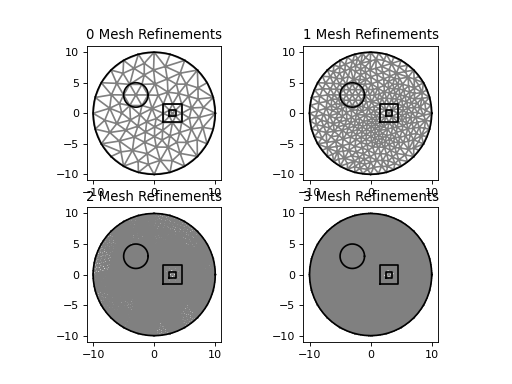
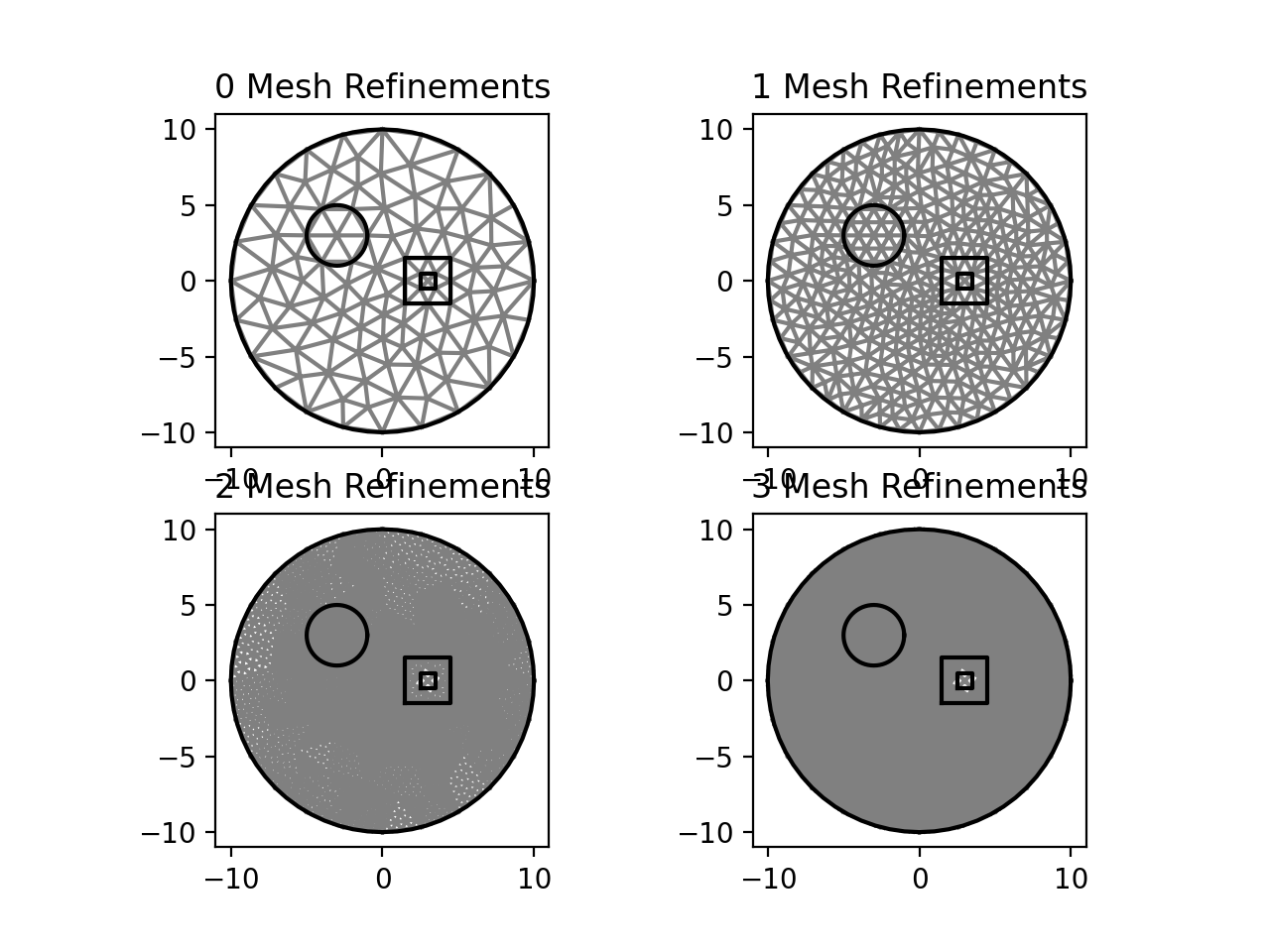
The parameters refine_domains and n_refine specify the which domains to refine and how many times the refinement
should be done. Each refinement operation breaks the mesh elements into smaller pieces so a high n_refine provides
a higher resolution mesh.
The refine_domains and n_refine parameters can be directly specified to Model.compile method or passed as
additional parameters to the IterativeSolver during parameter sweeps.